
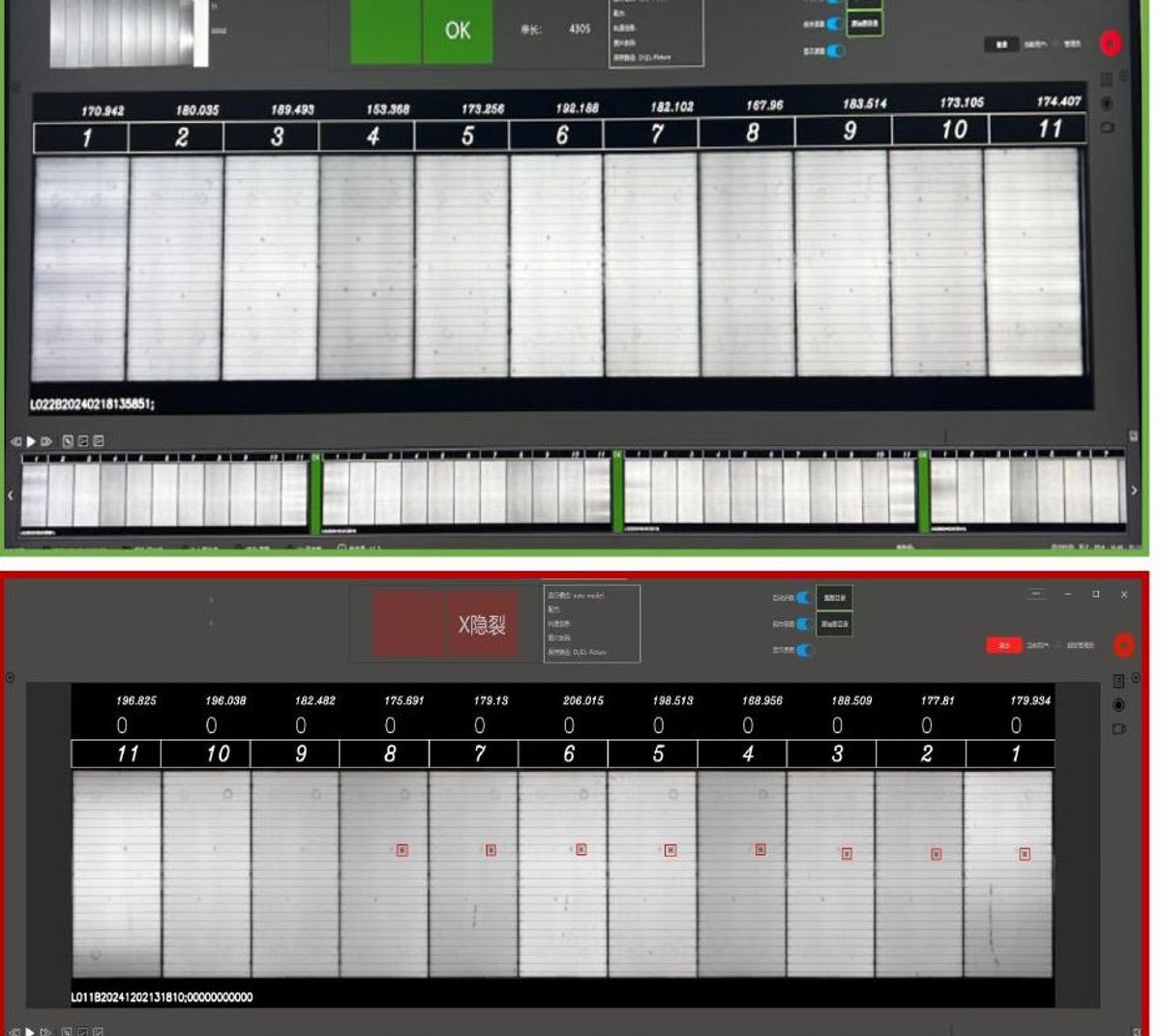
Half-cell formats first challenge alignment and consistency
Half-cell geometry makes position variation especially important because a small shift can change the valid inspection region. Alignment and cropping should first establish comparable cell boundaries across images. Defect recognition comes after that spatial baseline. If positioning continues to drift, models and rules receive different content, and the resulting decisions cannot be reviewed under one consistent interpretation.
Choose cropping and correction for the imaging scenario
Cropping and correction should match the acquisition scenario and the region that must be inspected. The purpose is to retain complete, relevant content while limiting border interference. Engineers should review the relationship among alignment evidence, crop boundaries, and half-cell edges so downstream methods receive the same semantic region. A product-format or imaging change requires that relationship to be confirmed again.
Use illumination and grayscale checks as an image baseline
Illumination and grayscale checks describe whether an image remains within its expected baseline; they do not replace defect recognition. These checks can expose changes in lighting, acquisition, or region content before inference. Placing image-quality assessment early in the workflow helps prevent an obvious input shift from being treated immediately as defect evidence and gives engineers a clearer path for review.
Combine deep learning, explicit rules, and region filters
Deep learning can recognize complex patterns, explicit grayscale conditions can express clear decision limits, and region filters can restrict where evidence counts. Each layer should carry a distinct, reviewable responsibility, with recipes organizing product-related conditions. The final defect result should come from validated combined logic rather than from one output whose production meaning has not been defined.
Pass decisions to sorting and quality systems
Recognition outputs must be aggregated before sorting and quality systems can use them. A workflow can connect defect classes and regions to a verified sorting decision while retaining statistics, alarms, images, and logs for review. Consistent inspection identifiers across those records allow engineers to trace a production action back to its image evidence and decision context.
Validation boundaries: diagnostics must not burden takt time
Diagnostics support deployment work, but they should not add an open-ended burden to production takt time. Thresholds, model versions, filter regions, image retention, and sorting mappings require product- and line-specific validation. The scope of diagnostic records also needs review against imaging conditions, evidence needs, and processing load so temporary investigation settings do not become an unexamined operating dependency.